
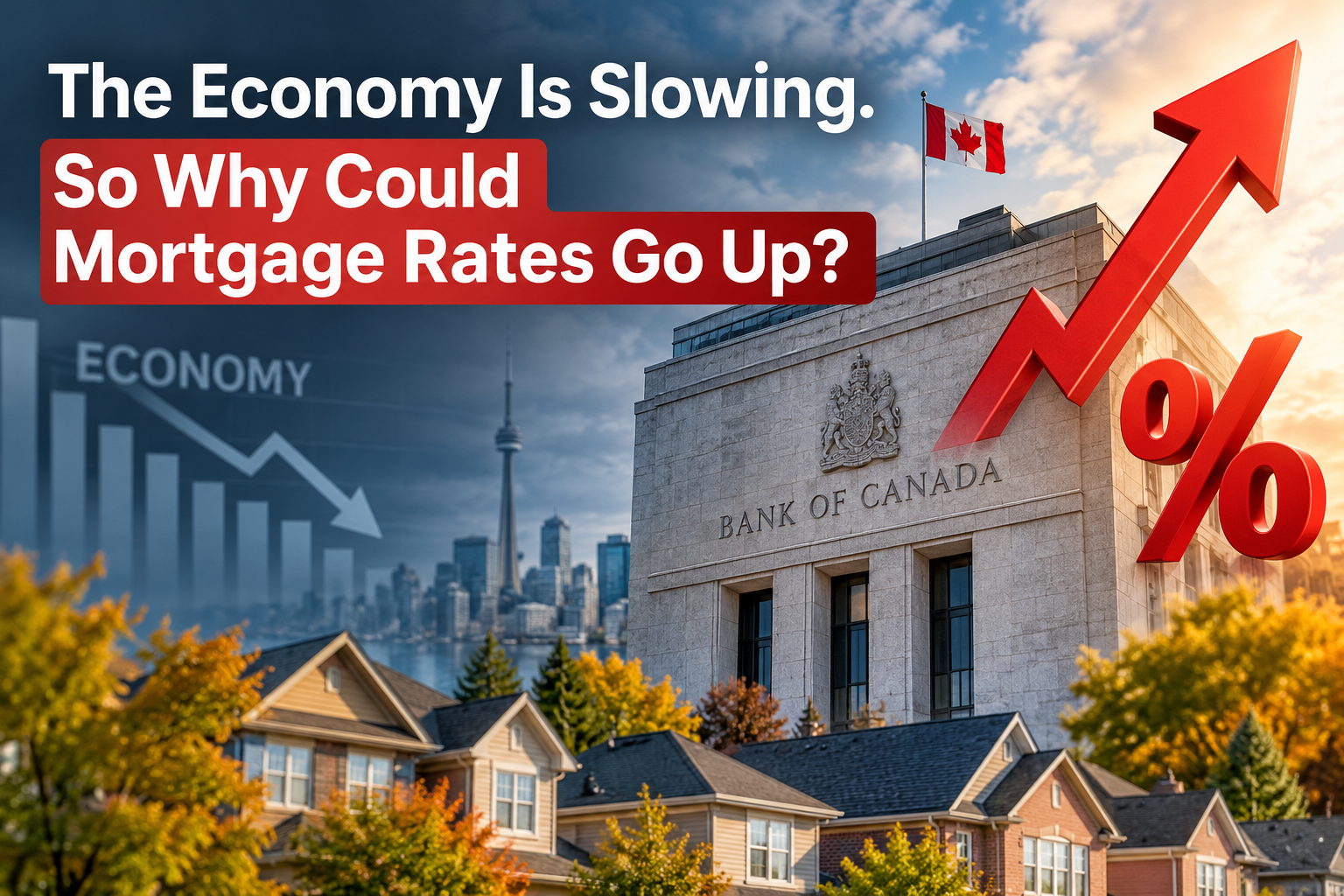
The Economy Is Slowing. So Why Could Mortgage Rates Go Up?
If you’ve been following the Canadian economy lately, you might be wondering why mortgage rates aren’t falling.
After all, when the economy slows, businesses struggle and consumers spend less, shouldn’t borrowing money become cheaper?
Normally, that’s what we’d expect.
But there’s a complication this time around, and it has a lot to do with inflation, energy prices and the Bank of Canada.
With another Bank of Canada interest rate announcement scheduled for Wednesday, October 28, homeowners may be in for a surprise.
The Bank of Canada Has a Difficult Decision to Make
The Bank of Canada’s overnight lending rate currently sits at 2.25%.
Ordinarily, a slowing economy would give the Bank of Canada a reason to consider lowering interest rates. Lower rates can encourage borrowing, support businesses and stimulate spending.
But the Bank of Canada has another important responsibility: keeping inflation under control.
And inflation is proving stubborn.
Statistics Canada’s latest report shows that Canada’s annual inflation rate rose to 3.1% in September, up from 3.0% in August.
One of the biggest contributors? Energy prices.
Gasoline prices increased 27.8% compared with September of last year. However, when gasoline is excluded, inflation was considerably lower at 2.2%.
That distinction is important because it suggests much of the recent increase in inflation is being driven by energy rather than widespread price increases throughout the economy.
Why Would Higher Gas Prices Lead to Higher Mortgage Rates?
Here’s where things get interesting.
When oil and gasoline prices rise, transportation and production costs can increase. Businesses may eventually pass some of those higher costs along to consumers.
The Bank of Canada worries that these price increases could spread throughout the economy and become more persistent.
One way central banks try to control inflation is by raising interest rates, making borrowing more expensive and discouraging spending.
But there’s a catch.
Higher interest rates won’t produce more oil, reopen disrupted shipping routes or directly lower gasoline prices.
They can, however, reduce demand throughout the broader economy.
That’s why the Bank of Canada faces such a difficult balancing act: raise rates too much and risk further weakening an already fragile economy, or leave rates too low and risk allowing inflation to become entrenched.
Could Interest Rates Actually Increase?
It’s possible.
According to a Reuters survey published October 23, 19 of 34 economists expected the Bank of Canada to increase its overnight rate by 0.25 percentage points at its October 28 meeting.
That would bring the policy rate from 2.25% to 2.50%.
But this is a forecast, not a certainty.
There are still arguments for holding rates steady, particularly given concerns about economic growth and the fact that much of the recent inflation increase has been energy-related.
Whatever the decision, it will give us another indication of where Canadian mortgage rates may be heading.
What Does This Mean for Your Mortgage?
The answer depends largely on the type of mortgage you have.
If You Have a Variable-Rate Mortgage
Variable mortgage rates are generally influenced by lenders’ prime rates, which tend to move with the Bank of Canada’s policy rate.
If the Bank raises rates by 0.25 percentage points and your lender passes along the full increase, your interest rate would normally rise by the same amount.
Depending on your mortgage structure, that could mean a higher monthly payment or a greater portion of your existing payment going toward interest rather than principal.
If You Have a Fixed-Rate Mortgage
Your existing fixed mortgage rate generally won’t change during your mortgage term.
However, if you’re approaching renewal or arranging a new mortgage, it’s important to understand that fixed rates are influenced more directly by bond yields and lender funding costs than by the Bank of Canada’s overnight rate.
This means fixed mortgage rates can move even when the Bank of Canada does nothing.
And sometimes fixed rates can increase while the economy is slowing.
Should You Wait for Mortgage Rates to Fall?
This is probably the question I hear most often.
And my answer is that trying to predict the exact bottom of the interest rate market is extremely difficult.
Even professional economists don’t always agree on where rates are heading.
Instead, I encourage homeowners to focus on what they can control.
If your mortgage is coming up for renewal, compare your options well in advance.
If you’re considering refinancing, look at your overall financial situation rather than focusing exclusively on the interest rate.
And if you’re purchasing a home, make sure the mortgage is affordable under a variety of circumstances.
Sometimes the mortgage with the lowest advertised rate isn’t necessarily the one that will save you the most money.
The Bottom Line
Canada’s economy is sending mixed signals.
Slower economic growth suggests interest rates should be lower, while inflation concerns suggest the Bank of Canada may need to keep rates elevated or even raise them.
Both arguments have merit.
The Bank of Canada’s October 28 announcement may provide greater clarity, but one thing is certain: there’s more to mortgage rates than the latest central bank announcement.
The best mortgage strategy isn’t necessarily about predicting where rates will go next. It’s about choosing the right financing for your circumstances, regardless of what happens next.
Have Questions About Your Mortgage?
Whether you’re buying a home, approaching renewal, refinancing or simply wondering if your current mortgage is still the right fit, I’m always happy to help.
Sometimes a quick conversation can uncover options you didn’t know were available.
Geoff Del Grande
Mortgage Agent | Rock Capital
GetMortgaging.com
Serving homeowners throughout Kitchener-Waterloo, Orangeville and surrounding Ontario communities.
This article reflects information available before the October 28, 2026 Bank of Canada announcement. Mortgage rates, qualifications and lender policies are subject to change.